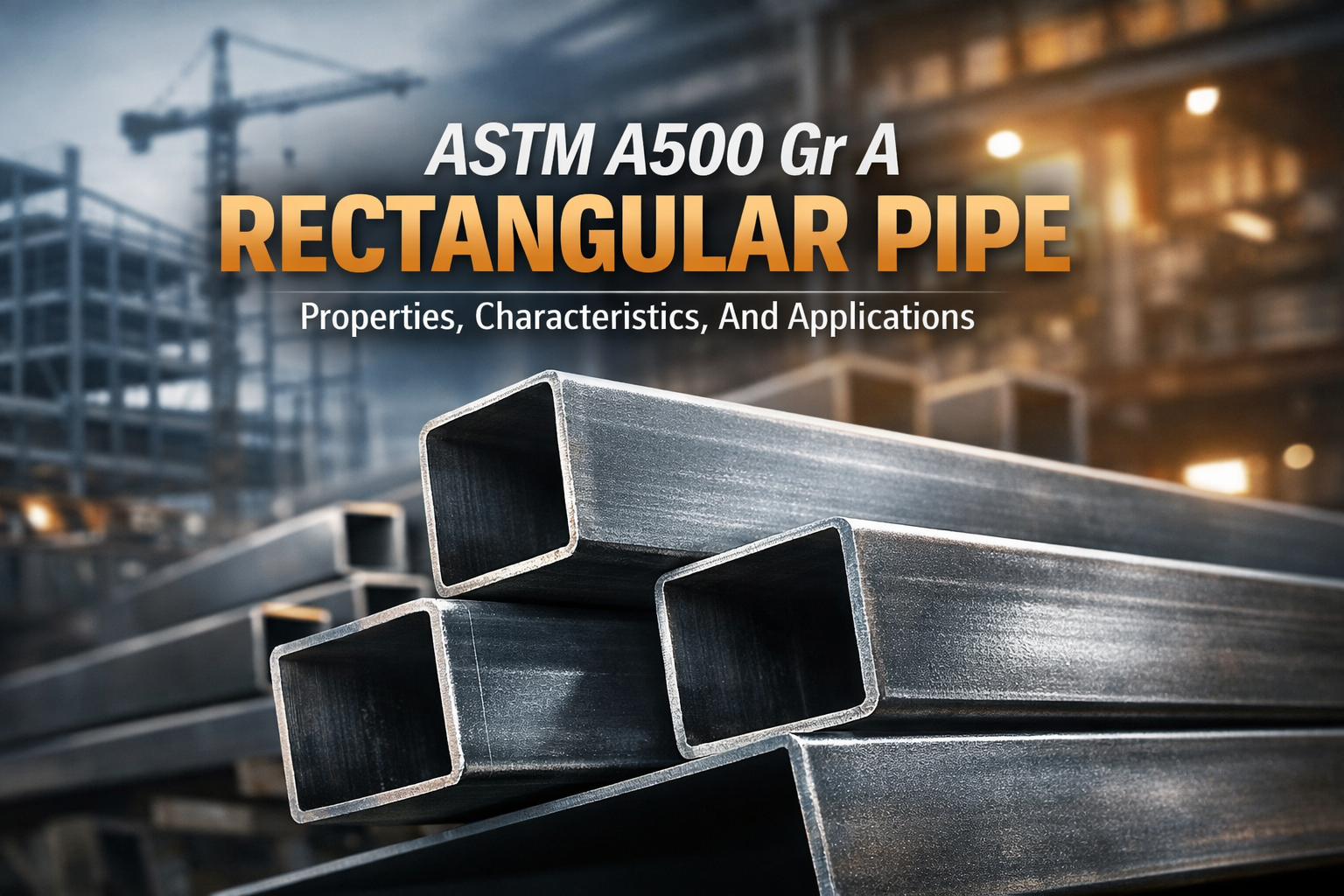
ASTM A500 Grade A rectangular pipe turns up on job sites more often than people realise. Walk past a mid-rise building frame or a roadside gantry and there is a fair chance this section is doing the quiet work inside the structure. It carries load without drama. That matters.
The grade sits within the ASTM A500 specification for cold-formed carbon steel structural tubing, and in the Grade A condition it delivers a minimum yield strength around 46 ksi, which gives engineers enough confidence to design lean sections that still handle real-world stress, shifting wind loads, and the daily strain a structure faces once it goes live. In this blog post, we will discuss the properties, characteristics, and applications of ASTM A500 Gr A rectangular pipe in detail.
ASTM A500 Gr A Rectangular Pipe Explained
In simple terms, ASTM A500 Gr A rectangular pipe is a hollow structural carbon steel section formed at room temperature. The shape works in real conditions. Corners stay sharp, faces remain flat, and that geometry makes a difference when crews are fixing panels, welding base plates, or aligning members on site where time is tight and tolerances cannot drift.
Because ASTM A500 Gr A rectangular pipe is cold-formed, the section gains additional strength during the forming process itself, and that subtle change in the steel’s internal structure improves load performance without pushing overall project costs beyond what mainstream construction budgets can manage.
Fabricators continue to specify ASTM A500 Gr A rectangular pipe for practical reasons. It welds cleanly in normal workshop conditions, it can be cut and drilled without excessive tool wear, and it responds well to protective finishes such as primer or galvanising when environmental exposure demands added durability. Work flows smoothly.
Properties Of ASTM A500 Gr A Rectangular Pipes
Strength is the first thing engineers check, but they also look at elongation and ductility because a structural member should not fail without warning. Grade A rectangular pipe shows stable mechanical behaviour under load, which allows it to absorb stress rather than pass it on sharply to connected elements. That balance keeps frames steady.
Surface finish also counts, especially when the steel is visible. The rectangular profile offers a relatively smooth outer face, and although minor mill marks can appear, fabrication teams usually find preparation straightforward before coating or painting. It saves time next to other rougher sections.
Moisture, heat, and urban pollution will always test carbon steel, so protection strategy matters; still, when properly coated or galvanised, this grade performs reliably in open environments, service yards, transport corridors, and similar settings where exposure is constant and maintenance budgets are watched closely.
Applications Of ASTM A500 Gr A Rectangular Pipes
Spend a day around a fabrication yard or a half-built commercial block and you will notice how often this rectangular section appears in the frame. It sits inside columns, edge beams, roof supports, sign structures, even small pedestrian bridge members where weight control matters but strength cannot be compromised. It just fits.
On projects where alignment is critical, the rectangular profile helps crews keep lines straight, because the flat faces sit cleanly against plates and brackets, and once welded in position the section tends to hold its geometry under repeated loading from wind, traffic vibration, or shifting internal loads.
In light industrial buildings, it is also used for equipment platforms and support frames, mainly because it offers predictable bending resistance and does not twist easily when loads move across the span during daily operation.
Commercial Considerations
Budget pressure is real on most builds. This grade works well in that space. Contractors choose it when they need structural performance without stepping into higher alloy costs, and suppliers generally keep a steady stock range in common sizes so procurement delays are less likely. Availability helps projects move.
Because it comes in multiple wall thicknesses and dimensions, engineers can fine-tune section weight against design load, which means they are not forced into overdesign, and that adjustment can reduce overall steel tonnage across a frame without affecting structural safety margins.
Fabricators also factor in labour. Straight cuts, manageable welding behaviour, and consistent dimensional tolerances reduce shop-floor time, which in turn lowers fabrication cost per ton, especially on repetitive commercial builds.
Conclusion
No structural material suits every job, yet ASTM A500 Grade A rectangular pipe continues to hold its ground in mainstream construction because it delivers stable mechanical strength, workable fabrication behaviour, and reasonable long-term durability when surface protection is properly specified. It does the heavy lifting.
For developers, contractors, and engineers working on warehouses, transport sheds, multi-storey car parks, or industrial units, this section offers a straightforward structural solution that balances design flexibility with cost control, while still meeting the performance expectations tied to the ASTM A500 specification.